Fierce Compassion Melts Ice
Written by Michael Kearney, M.D., MHP Co-Founder
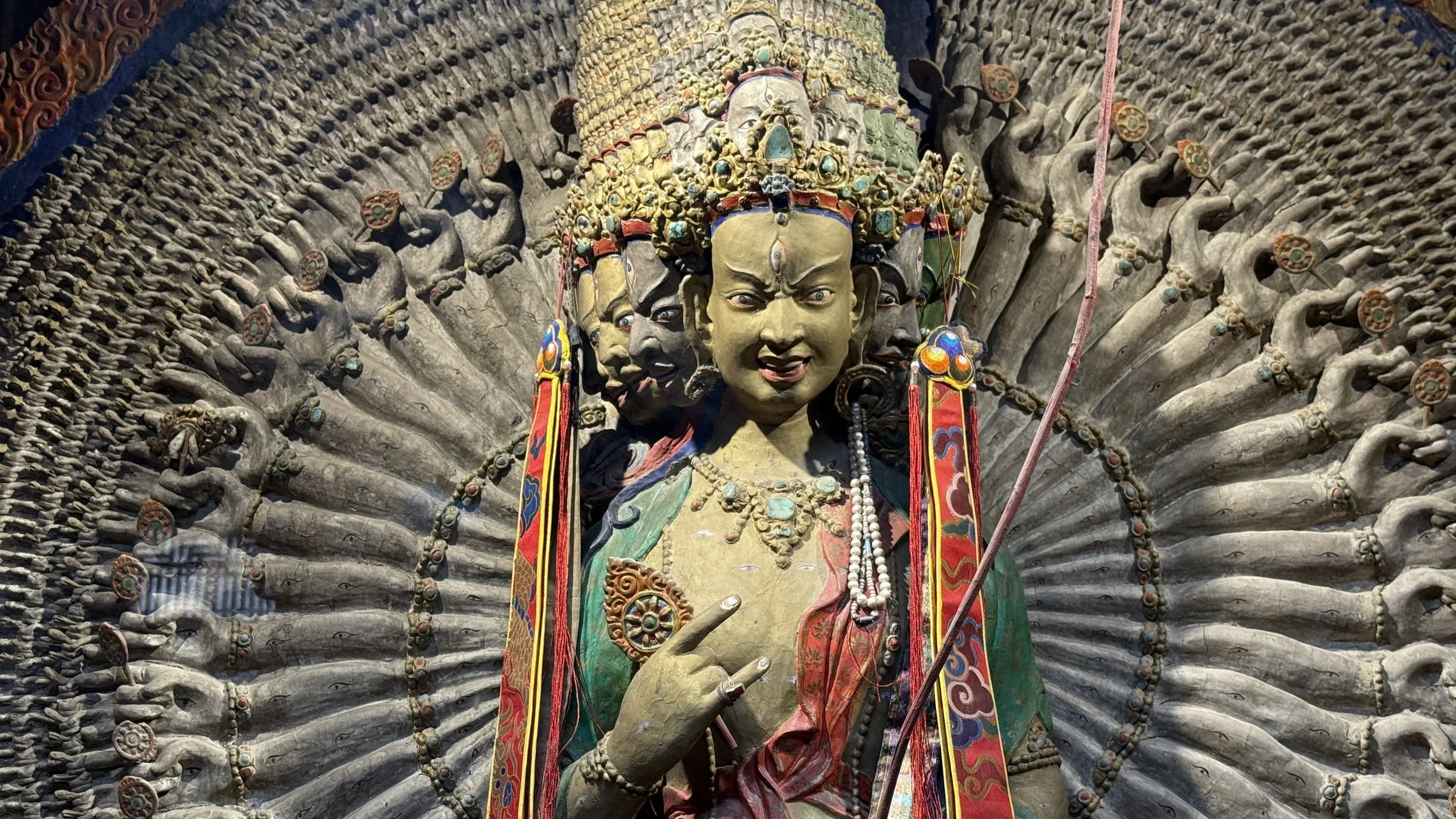
This is Chenrezig, also known as Avalokitesvara, recognized in Tibetan Buddhism as the Bodhisattva of Compassion. As you can see in the image, Chenrezig has countless heads that face in every direction. She also has countless arms that reach out to every sentient being who is suffering, connecting, calming, consoling, and comforting.
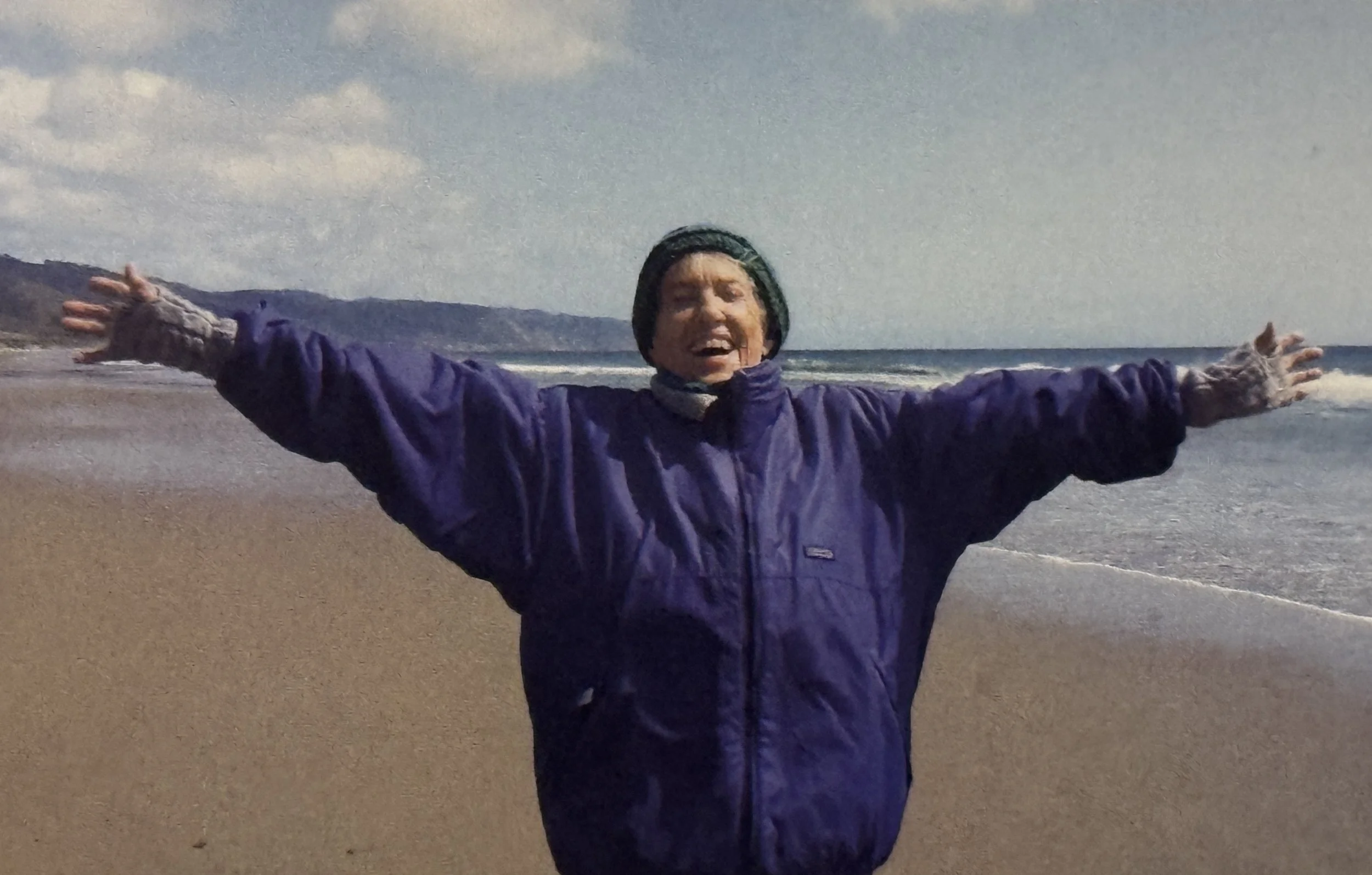
It was early August 2025 when Radhule and I were traveling in Ladakh, Northern India, that we stood together in a Buddhist monastery looking up into that intense, “take-no-prisoners” gaze. We were reminded of our dear friend and mentor, Joanna Macy (pictured here at the beach), who had died just a few weeks earlier. She, too, was a Bodhisattva and a fierce Shambhala warrior of compassion at one with the blazing heart of life and wanting to share that warmth and light with all she met, especially those who were struggling, lonely, and afraid.
As I write this, most of the United States is trying to cope with ice, ICE, or a combination of the two. In one way or another, we are experiencing a chilling presence in our communities. Ice shuts things down. It hardens and causes what’s soft to retreat inside and close the door. ICE triggers fear, creating hate, polarization, and division. The cold of ice is the opposite of warmth. The terror of ICE is the opposite of compassion.
Finding Compassion
Yesterday, a headline in The Guardian newspaper caught my attention: “The womansphere urges dubious followers to back ICE: ‘Don’t let compassion cloud you.’” I read on:
“Riley Gaines, one of the leading figures of the ‘womansphere’ movement, who promotes an anti-feminist, gender-essentialist agenda to their followers, pleaded with her flock not to feel bad for victims of ICE cruelty… ‘Do not let compassion, or what you believe to be compassion, cloud you or suspend you from thinking critically,’” she said.
According to The Guardian, Allie Beth Stuckey, who published a book called Toxic Empathy: How Progressives Exploit Christian Compassion, preaches that empathy can make Christians weak because it allows reflexive horror over systemic violence and cruelty to cloud their objectivity. “Show empathy to the wrong person – immigrants, people of color, the disenfranchised, or anyone who defends their rights – and you are a pawn of progressives who wish to weaponize the concept of caring for one another to feed you a lie” she said, later adding, “There are a lot of people out there who want you to be dumb. Know that, women, I want you to think. Because women, you are not just feelers.”
The message here addressed to women, but relevant to all of us, is this: “Don’t trust your feelings, don’t trust your heart. Don’t be empathic or compassionate—it will only make you vulnerable to exploitation by those who mean you and our cause harm.” The ideology behind this advice is cruel, cold, and wrong. This is not who we are. This is not who I am.
Nature’s Wisdom
Just a few weeks ago, I was sitting in the rain, in the early morning, on a huge granite rock in Big Sur. As I sat there, listening to the sounds of the gentle rain in the foliage around me, I was aware of the rock’s ancient presence beneath me. Then I heard, or perhaps more accurately felt these words, “I am your holding; you are my warmth.”
This came without shock or surprise. It seemed the most natural thing in the world. The igneous rock beneath me was once molten magma in the Earth’s core. Over 200 million years, it had cooled into the cold I felt beneath me. I was very aware of my softness and transience in its hard, timeless presence. I was also aware of my warmth. “I am your holding; you are my warmth.”
So, who am I? I am the Earth core’s, the Sun’s, a star’s warmth, with the capacity to choose where and to whom I offer my warmth in an icy world. Warmth with intentionality is what defines us as the little, wonderful, human animals we are.
All the great spiritual traditions agree that compassion, feeling with another who is suffering and acting to relieve that suffering, is a core value. For example, in the Christian tradition, St. John writes, “All is love, and love is all,” and in St. Matthew’s Gospel we’re told that “Whatever you do to the least of these you do to me.”
In Buddhism, the Dalai Lama says, “My religion is compassion,” adding, “if you want to be happy, practice compassion, and if you want others to be happy, practice compassion.” Zen Buddhist teacher Thich Nhat Hanh coined the term “interbeing” to describe our deepest essence, a profound truth evident in our interdependence with the rest of the natural world, of which we are indivisible parts, neither superior nor apart.
We are One
The “Big Lie” is that we are separate and siloed, as individuals, as cultural or political groups, as species, as nations. But Joanna reminds us that, in our deepest nature, we all share a common identity as “planet people.” The Earth is our mother, not metaphorically but literally; everything we are and have comes from her. We are all her children and, like it or not, all part of one big, very diverse and beautiful family. And deeper still, we are all expressions of the Great Love, the blazing heart of the cosmos that exploded into life with the Big Bang and continues to create, expand, and diversify in countless ways we cannot even imagine.
As for the macrocosm, so for the microcosm, that is every human heart. When we are experiencing an emotion, be it sadness, joy, delight, anxiety, or gratitude, and someone asks us, “Where in your body do you feel this?” we don’t put our hands on our heads. It will be somewhere else in our body, usually in the center of our chest, in the area of our heart. As Alice Miller reminds us, “The body doesn’t lie.”
Lama John Makransky, who will be in Santa Barbara on April 25 to lead a day-long retreat, teaches us that if we can be hospitable to our feelings and not react to them, if we can simply welcome them with spaciousness, warmth, and deep allowing, they bring us home to our deepest nature, even to the very ground of being. As this happens, we realize the profound truth in novelist Henry Miller’s words: “I know what the cure is: it’s to give up, to relinquish, to surrender, so that our little hearts can beat in unison with the great heart of the world.”
In our deepest nature, we are love, we are warmth, we are kindness. Our little hearts are blazing coals from the great furnace that is the heart of the world. This is who we are. This is who everyone, even those we consider “other” or even “enemy,” is in their deepest identity.
It matters that we remember this. It matters that we re-member this, so that we can become the change we want to see in the world. Then, like Chenrezig, and dear Joanna, we become the fierce, warm compassion that heals, softens, and melts ICE.